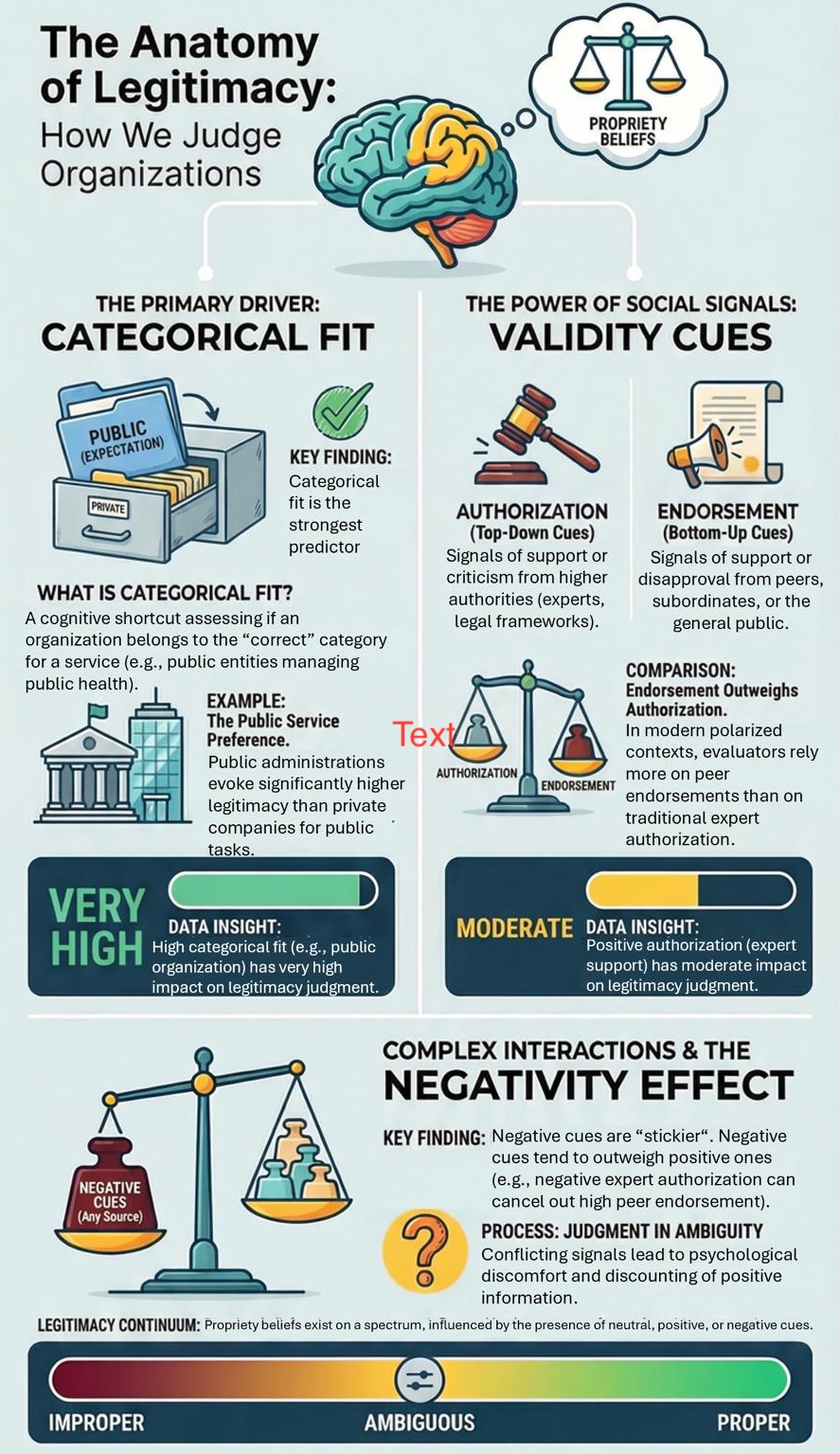
by Thaler, J., Sievert, M., Siraz, S. S., & Pinz, A. Journal of Management Studies.
Summary
In their 2026 article published in the Journal of Management Studies, Julia Thaler, Martin Sievert, Sonia Siraz, and Alexander Pinz make an important contribution to organizational legitimacy research by explaining, at the microlevel, how evaluators form propriety beliefs about organizations.
Its first major contribution is to show that legitimacy judgments are shaped not only by validity cues such as authorization and endorsement, but also by their valence and combination. Across two preregistered factorial vignette survey experiments in Germany, with a combined final sample of 1,866 respondents, endorsement cues were generally more influential than authorization cues. At the same time, the study shows that negative authorization is especially consequential, consistent with a negativity effect: even when endorsement is high, criticism from authorities or experts can substantially depress propriety beliefs. The findings further suggest that propriety beliefs exist on a spectrum, influenced by neutral, positive, and negative cues. The study therefore refines legitimacy-as-perception theory by showing that evaluators interpret validity cues differently depending on how those cues align, conflict, or signal undecided/unknown legitimacy rather than clear legitimacy or illegitimacy.
The article’s second and most novel contribution is the introduction of perceived categorical fit as a distinct cognitive mechanism shaping propriety beliefs. Evaluators rely heavily on category labels such as public versus private to assess whether an organization belongs in a given domain, and that perceived categorical fit emerges as the strongest and most consistent predictor of propriety beliefs. By integrating legitimacy-as-perception with categorization theory, the study offers a richer account of how microlevel legitimacy judgments are formed and why some organizations face legitimacy penalties even before other information is processed.
Link to the full article online:
https://doi.org/10.1111/joms.7009